Umemoto et al. EuroIntervention 2017
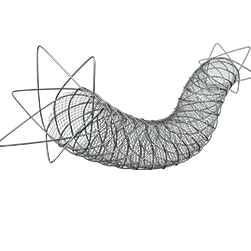
Featured product: Roadsaver™ Carotid Artery Stent
-
Prospective, 2-arms, 2 Italian centers
- CAS procedures performed between October 2014 and July 2015
-
16 consecutive patients (15 males, mean age: 75.0±7.5) undergoing CAS using the dual-layer micromesh stents (11 CGuardTM / 5 RoadsaverTM) with OCT
- 3 Symptomatic > 50% stenosis (19%)
- 13 Asymptomatic >80% stenosis (81%)
-
The primary endpoints were the incidences of Stent Malapposition and Plaque prolapse as detected by OCT (according to the implanted stent).
-
Secondary endpoints included the presence of either stroke or death at 30 days and any in-hospital adverse events.
-
Independent neurological examinations of all patients were performed before the intervention, at discharge, and at 30 days after the procedure.
-
Embolic protection devices (EPD) use: 100%
- 56.3 % Proximal (Mo.Ma™ Ultra),
- 9 CGuardTM (81.8%) / 0 Roadsaver™ (0%) (p=0.005)
- 43.8% Distal protection (5 Spider FX™ (%) / 2 FilterWire EZ™ (%))
- 2 CGuard™ (18.2%) / 5 Roadsaver™ (100%) (p=0.005)
- 56.3 % Proximal (Mo.Ma™ Ultra),
-
Stent size selection
- The stent diameter was selected according to the common carotid artery (CCA) diameter (mean oversize of 1 mm),
- The stent length was calculated to cover the entire carotid lesion (at least 0.5 cm below and 0.5 cm above the target lesion).
-
Predilatation: 4 (25%), 4 CGuardTM (36%) / 0 RoadsaverTM
-
Nominal stent length: 32.4±6.2 mm,
- 35±5.2 mm CGuardTM vs. 27.5±2.9 mm RoadsaverTM (p=0.02)
-
Postdilatation: 100%
-
Contrast volume: 82.8±34.1 ml,
- 93.5±38.7 ml CGuardTM vs. 55±13 ml RoadsaverTM (p=0.13)
-
Procedural time: 61.0 ± 24.9 min,
- 66.5±28.0 min CGuardTM vs. 41.3±4.8 min RoadsaverTM (p=0.04)
-
Technical success (i.e. CAS procedure achieving <30% residual stenosis): 100%
-
No major complications (any TIA / stroke / death up to 6 months post-procedure)
-
Incidence of Stent Malapposition and Plaque prolapse
- Stent Malposition:
- 20.5% CGuardTM vs. 26.8% RoadsaverTM, (p=0.26)
- Plaque prolapse:
- 10.8% CGuardTM vs. 20.7% RoadsaverTM (p=0.05)
- Stent Malposition:
- A small number of patients (unequal groups)
- Stent selection depended on the physician's discretion
- Although DW-MRI imaging at 30 days would be the final demonstrator of the relevance of OCT-detected it was not performed