Long-Term Outcomes of Balloon TACE for HCC: An European Multicentre Single-Arm Retrospective Study
2
Featured product: Occlusafe™ Temporary Occlusion Balloon Microcatheter
neutrals-100
true
false
Background
Background
Objective
Objective
Methods
Methods
Conclusion
Conclusion
KeyTakeaways
Key Takeaways
Background
3
Occlusafe Balloon-occluded transarterial chemoembolization (B-TACE), either with Lipiodol-based TACE (cTACE) or drug-eluting microsphere TACE (DEM-TACE) previously demonstrated to provide better tumor response rates in terms of Complete Response (CR), and this could lead to improved clinical outcomes. Satisfactory results were observed and reported even in hepatocellular carcinoma (HCC) lesions of 3–5 cm in diameter which are known to have worst outcomes.
Objective
3
To further evaluate the clinical impact of Occlusafe b-TACE, a long-term oncological evaluation was performed on the previous cohort of treated patients for whom at least 12 months FU data were available. Data collected included response rates using mRECIST, Overall Survival (OS) and Local recurrence-free survival (LRFS).
Methods
3
- Multicentric retrospective study with patients from five European centres, treated for HCC with
- Occlusafe b-TACE (conventional or drug-eluting microsphere TACE)
- Response was evaluated at 1 month after the procedure and then every 3 months afterwards.
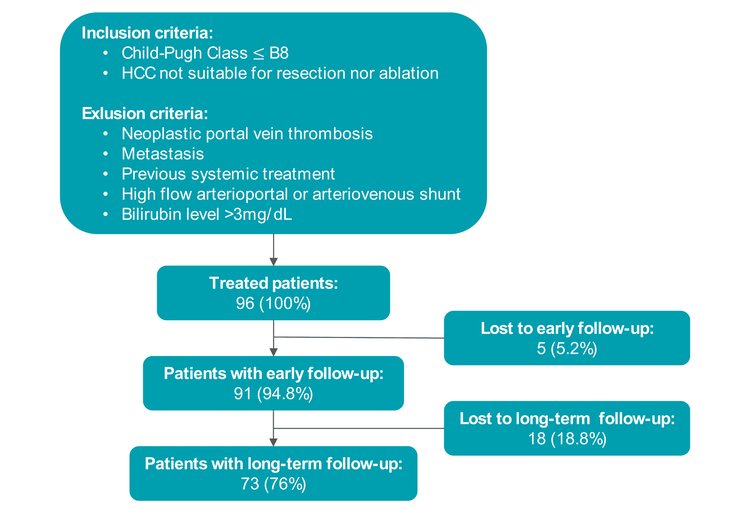
Mean number of nodules was 2.07 ± 1.68 and mean maximum diameter in mm was 37.0 ± 19.9.
Complete response rate at 6 months was 58.9%, and 49.3% at the last available follow-up (median 31 months), confirming the importance of reaching and maintaining CR to obtain longer OS. The majority of patients (75,4%) did not need further retreatments during the entire FU.
Median LRFS was 31 months and OS was 50 months. The mean OS observed for the 32 (43,8%) patients classified as BCLC B was 42 months, longer than the 2,5 years expected for this sub-population.
Conclusion
3
Occlusafe b-TACE demonstrated high efficacy for HCC, with a complete response in 58.9% of patients, a median local recurrence-free survival of 31.0 months and a mean overall survival of 50.0 months. The flow modification induced by the balloon microcatheter may have provided for denser accumulation of embolics in the lesion, leading to these good oncological results. Results are reproducible in different countries/sites and for different TACE technical approaches.
Key Takeaways
3
- Occlusafe b-TACE demonstrated high efficacy for HCC, with a target complete response in 58.9% of patients at 6 months of follow up, and 49,3% after a median follow up time of 31 months.
- At the end of follow up, a median local recurrence-free survival of 31.0 months and a mean overall survival of 50.0 months were observed.
- After the initial treatment up to the end of the entire follow up 55 patients (75,4%) did not needed further treatment sessions for the target lesions; only 18 patients (24,6%) received another locoregional treatment (TACE, TARE, thermal ablation).
- The flow modification induced by the balloon microcatheter may have provided for denser accumulation of embolics in the lesion, leading to these good oncological results.
- Results were reproducible in different counties/sites and for different TACE technical approaches.
Featured products
3
default-carousel
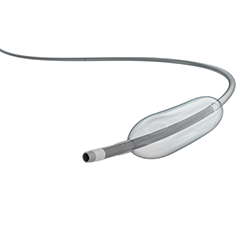
Occlusafe™
Temporary Occlusion Balloon Microcatheter