-
Prospective, Single-arm, Single-center
- Enrolment between September 2015 - January 2016 at a high-volume Italian center
-
23 consecutive patients (Mean age: 74 ± 7, 19 (82.6%) males)
-
Principal inclusion criteria were 18 or more years of age and carotid artery stenosis
- 60.9 % (14) Symptomatic patients, with ≥50% evaluated by duplex ultrasound (DUS) according to the NASCET criteria
- 39.1 % (9) Asymptomatic patients, with ≥80% and suitable for treatment according to the vascular and neurological specialist
-
Patients were scheduled for DW-MRI evaluations at baseline, 24 h and 30 days post-stenting, and clinical evaluation and DUS at baseline, 24 h, 30 days, and 6 months post-stenting
-
The clinical evaluation included a neurological examination performed by an independent neurologist using the National Institute of Health Stroke Scale (NIHSS) and cognitive tests as the Mini-Mental State Examination and the Frontal Assessment Battery
-
Procedural success was defined as stenting achieving <30 % residual stenosis with no complications
-
The intracranial circulation was visualized before and after the procedurę.
-
Co-medication:
- Before the procedure, all patients received dual antiplatelet therapy (DAPT; i.e. 100 mg acetyl-salicylic acid (ASA) and a loading dose of 375 mg clopidogrel (unless already on DAPT)).
- During the procedure, ACT-based heparinization was administered using weight adjusted initial dosing. 1 mg of atropine was administered after stent dilatation.
- After the procedure, patients received a daily dose of DAPT (100 mg ASA and 75 mg clopidogrel) for one month, and only ASA thereafter.
-
Embolic protection device (EPD) use: 100%
- Emboshield, Abbott Vascular in all patients
-
The same 2 operators with extensive experience (50 CAS/year as first operators in last 10 years) performed all procedures.
-
All MRI studies were performed with a 1.5 T scanner (Achieva, Philips, Best, The Netherlands).
- For a detailed summary of different imaging parameters and related analyses, see the original manuscript.
-
The pre-procedural DW-MRI did not detect any acute ischemic lesions in any patient.
-
In 7/23 (30.4 %) patients the 24-h post-procedure imaging showed new asymptomatic (silent) ischemic cerebral lesions (4/7 stand-alone ipsilateral & 3/7 with additional contralateral lesions).
- 15 new ipsilateral (median volume 0.076 cm3) ischemic lesions
- 6 contralateral (median volume 0.044 cm3) ischemic lesions
-
The number of ipsilateral lesions in a single patient ranged from 1 to 4 (median 3 lesions/patient).
-
No statistically significant differences in the baseline (presence of risk factors) nor in the procedure management was detected among patients with and w/o the post-CAS cerebral embolization.
-
Most lesions were found in symptomatic patients (73 %) and in patients presenting with unstable plaques.
-
The 30-day imaging showed complete resolution of all lesions and no new ischemic lesions.
-
Follow-up clinical and ultrasound examinations at 30 days and 6 months recorded no adverse cardiac or cerebrovascular events, while the ECA was patent in all cases.
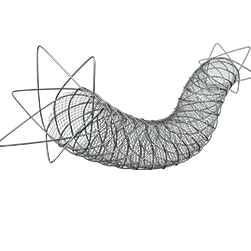
- Protected stenting with a dual-layer micromesh RoadsaverTM stent shows good safety and efficacy in the treatment of carotid stenosis.
- The incidence of new ischemic brain lesions after CAS with the Roadsaver stent indicates that this stent may exert intrinsic embolic protection and positively impact outcomes.