-
Prospective, Non-randomized, 2-arm, Single-center
-
1 High-volume Italian canter
- Enrolment between September 2016 and December 2017
-
50 CAS patients (median age 74 years; 33 males)
-
37/50 (74%) patients with primary carotid stenosis had DW-MRI of the carotid plaque pre-procedure, with:
- Qualitative evaluation (signal hyperintensity)
- Quantitative ADC (apparent diffusion coefficient) measurement
-
-
Patients presenting with symptomatic stenosis ≥50% (N=29 (58%)) and asymptomatic stenosis ≥ 80% (N=21 (42%)), as per NASCET, were included after multidisciplinary evaluation.
-
Patients >80 years old, with carotid obstruction, endoluminal thrombus, acute stroke within 30 days, myocardial infarction within 72 h, intracranial hemorrhage in the previous 12 months were excluded.
-
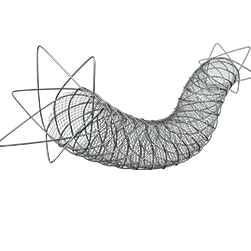
Patients received either RoadsaverTM (N=25) or CGuardTM (N=25) stent
-
All patients had brain DW-MRI pre-procedure, at 1 h, 24 h, and 30 days post-procedure to evaluate the appearance of hyperintense lesions over time.
- Imaging analysis was performed in a double-blinded fashion by two radiologists.
-
The clinical evaluation & Duplex ultrasound (DUS) examinations were done at baseline, 24h, and 30 days post-procedure.
- The clinical evaluation included a neurological examination performed by an independent neurologist using the National Institute of Health Stroke Scale (NIHSS).
-
Procedural success was defined as residual stenosis after stenting of <30% and no complications.
-
The outcomes of interest were the incidence, volume, and timing of new ischemic brain lesions.
-
Predictors were type of stent used and hyper intensity of the carotid plaque in the pre-procedural DW-MRI
-
The intracranial circulation was evaluated before and after the procedure.
-
Co-medication:
- Before the procedure, all patients received dual antiplatelet therapy (DAPT; i.e. 100 mg acetyl-salicylic acid (ASA) and a loading dose of 375 mg clopidogrel (unless already on DAPT).
- During the procedure, ACT-based heparinization was administered using weight adjusted initial dosing. 1 mg of atropine was administered after stent dilatation.
- After the procedure, patients received a daily dose of DAPT (100 mg ASA and 75 mg clopidogrel) for one month, and only ASA thereafter.
-
Embolic protection device (EPD) use: 100% (Emboshield, Abbott Vascular in all patients)
-
The same 4 operators with extensive experience (50 CAS/year as first operators in last 10 years) performed all procedures.
-
No pre-dilation needed
-
All MRI studies were performed with a 1.5 T scanner (Achieva, Philips, Best, The Netherlands), with a 16-channel PMS SENSE Neurovascular MRI Coil (Philips, Best, The Netherlands).
- For a detailed summary of different (cerebral & plaque) imaging parameters used, as well as related analyses that were applied, see the original manuscript.
-
Two experienced radiologists, double blinded to the study timing and the patient data, evaluated all MRI images qualitatively and quantitatively.
- In case of disagreement, the examinations were submitted to a senior radiologist
-
Pre-procedural brain DW-MRI did not evidence any acute ischemic lesions
-
Procedural success was achieved in 100% of cases, with no device or procedure-related adverse events recorded
-
No statistically significant differences were noted between the two stents, in terms of new lesion
- Incidence at 1 h (p = 0.23) & 24 h (p = 0.36)
- Volume at 24 h (p = 0.27).
-
A total of 34 new asymptomatic (silent) lesions in 19 patients (38%) were reported:
- 28 (82%) ipsilateral & 6 (18%) contralateral
- 4 (11.8%) at 1 h, 30 (88.2%) at 24 h.
- The 30-day cerebral DW-MRI showed complete resolution of all lesions and no evidence of new lesion.
-
The 30-day DUS showed that all ECA and stents were patents without any In-Stent Restenosis (ISR).
-
No major cerebrovascular event or a worsening of the neurological and cognitive conditions was detected upon clinical and neurological evaluations.
-
The incidence of new lesions at 24 h was significantly higher in patients with hyperintense carotid plaques (as per baseline DW-MRI)
- 12/16 (75%) vs. 0/21 (0%) (p < 0.0001).
- This result was paralleled by the difference in ADC value (0.83 ± 0.21 vs. 1.42 ± 0.52 x 10⁻³ mm2/s, p = 0.0004)
- No significant differences were evidenced in incidence and volume of intra- and post-procedural ischemic lesions between the dual layer micromesh RoadsaverTM and CGuardTM stent.
- The majority of early asymptomatic (silent) brain lesion occurred during the first 24 h after CAS
- The pre-procedural DW-MRI evaluation of the carotid plaque was a reliable predictor of early post-procedural embolization events after CAS.
- Hight plaque signal intensity associated with the increased microembolization incidence
Link to the full publication: https://doi.org/10.1007/s00270-019-02173-1