Contemporary Results of Carotid Artery Stenting Using Low-Profile Dual-Metal Layer Nitinol Micromesh Stents in Relation to Single-Layer Carotid Stents
2
neutrals-100
Kahlberg et al.
Featured products: Roadsaver™ Carotid Artery Stent
neutrals-100
true
false
s1
Objective
s2
Study Group
s3
Procedure
s4
Results
s5
Follow-up
s6
Conclusion
Objective
3
neutrals-100
To compare patient characteristics, procedure, perioperative and mid-term results of the carotid artery stenting (CAS) with the dual-layer micromesh RoadsaverTM stent vs single-layer stents.
neutrals-100
Study Group
3
neutrals-100
-
Single-center, retrospective, non-randomized study
-
200 consecutive patients; n=205 elective CAS procedures performed between April 2015 and December 2018
- 97 patients treated with Roadsaver™
- 88 patient patients treated with 1st-generations stents (Precise Pro Rx™, Xact, Carotid Wallstent™ & Cristallo Ideale™)
- 15 patients treated with CGuard™
-
Primary endpoint:
- The occurrence rate of Major Adverse Cerebrovascular Events (MACE; including death, ipsilateral stroke, and TIA)
-
Secondary endpoints:
- In-Stent Restenosis (ISR) rate
- Re-intervention rate
- Adverse cardiovascular events (i.e. including myocardial infarction, arrhythmias, and need for inotropic support.)
neutrals-100
Procedure
3
neutrals-100
- Patients treated with Roadsaver presented more «high-risk»* plaques
- Defined as SVS grade 2 (moderate risk) and 3 (severe risk), i.e. multi-fibrous plaque, ulcerated, thin capsule, multiple calcifying stenosis, or lipid / necrotic core
- Roadsaver patients were more often symptomatic and had more frequently previous brain lesions as detected by pre-procedural CT scan
- CAS with Roadsaver was performed more frequently through radial access (> 4x) and required less cervical cut-down
- CAS procedures with Roadsaver were significantly shorter
neutrals-100
Results
3
neutrals-100
- No death, stroke or myocardial infarction in patients treated with the Roadsaver™ stent
- No significant differences in primary endpoint (stroke/TIA/death)
neutrals-100
30-day Outcomes
neutrals-100
Follow-up
3
neutrals-100
(22.3 + 13.9 months)
-
No significant differences in primary patency (p=0.95) at 1 year (100% vs 99%) and 3 years (93.4% vs 94.3%), in Roadsaver™ dual layer vs single layer stent group.
-
No significant difference in long term survival (p=0.51) at 1 year (95% vs. 94%) and 3 years (92.6% vs. 90.1%) in the Roadsaver™ dual layer vs single layer group, (p=0.51
-
Roadsaver™ group
-
5 In-Stent Restenosis (ISR)
- 3 asymptomatic (not treated)
- 1 ISR resulting in ipsilateral stroke (at 34 months) with a pre-occlusive lesion),
- 1 ipsilateral TIA with a calcified plaque and intimal hyperplasia treated by DCB)
-
no stent occlusion
-
-
Single layer stent group
-
5 ISR
- 2 not treated
- 1 ipsilateral stroke (at 42 months) with intimal hyperplasia
- 1 asymptomatic post-irradiation ISR with ulcerated plaque and irregular borders which required stenting
- 1 pt refused reintervention
-
1 stent occlusion
-
neutrals-100
Conclusion
3
- Due to its technical features, operators tend to select Roadsaver for use in high-risk cases (in symptomatic pts, with vulnerable plaques & difficult access)
- Despite expected higher rate of complications in these patients, CAS with Roadsaver™ resulted in very good clinical outcomes (early and late)
- Roadsaver low-profile and high deliverability allow more frequent use of radial access, avoid cervical surgical cut-down, reduce arch manipulation, and decrease procedural time
neutrals-100
Featured products
3
default-carousel
default-carousel
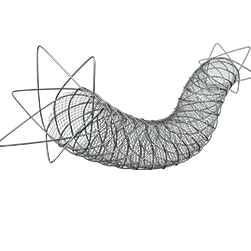
Roadsaver™
Carotid Artery Stent