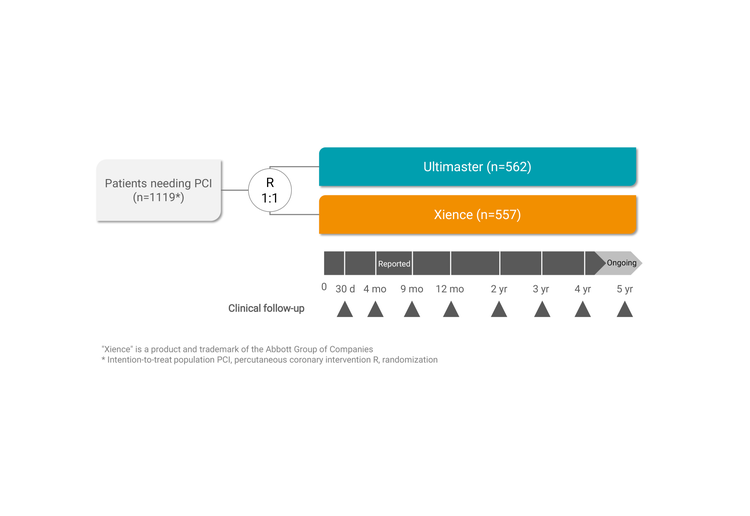
- Multicentre, intercontinental study: 58 sites in 13 countries across Europe, Japan, and South Korea
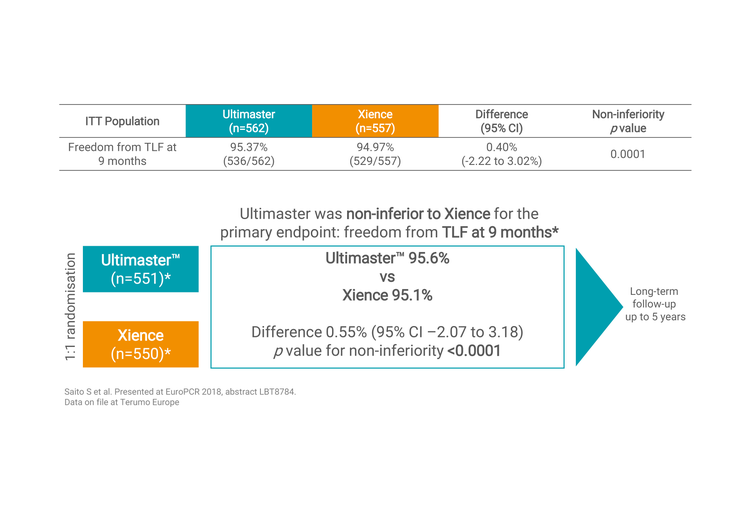
- Primary endpoint: freedom from TLF at 9 months
- Secondary endpoint: rate of TVF; patient-oriented composite endpoint; rate of TLR, TVR, ST, cardiac death, MI; composite of cardiac death and MI; rate of bleeding and vascular complications
- Clinical follow-up up to 5 years
- Stage: Published and completed
Featured products: Ultimaster™ Tansei™ Sirolimus Eluting Coronary Stent System, Ultimaster Nagomi™ Sirolimus Eluting Coronary Stent System
TLR, target lesion revascularization
TLF, target lesion failure
CI, confidence interval
MI, myocardial infarction;
NS, not significant;
ST, stent thrombosis;
TV, target vessel.
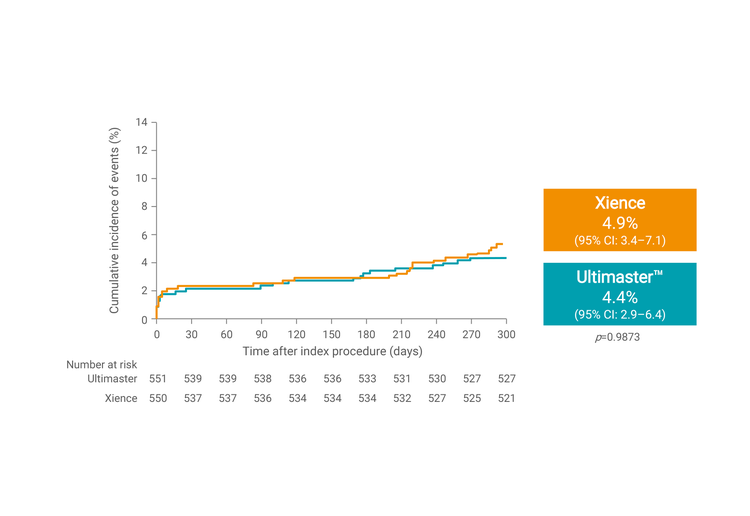
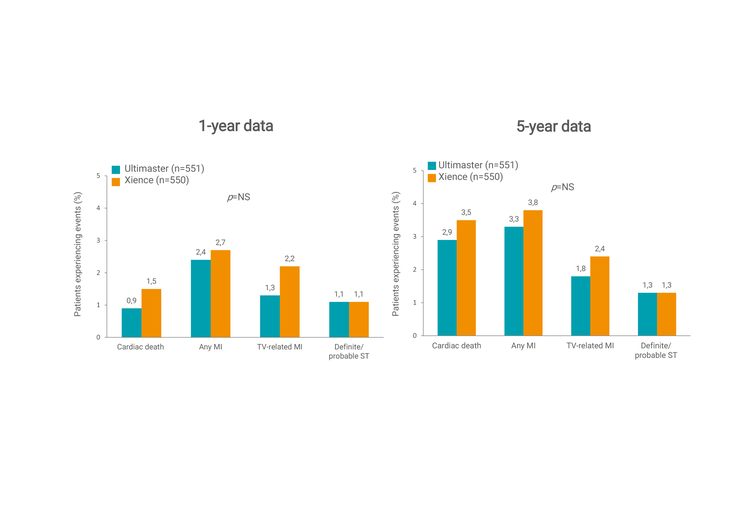
- There were no significant differences in baseline patient characteristics or bifurcation lesion characteristics between the two groups
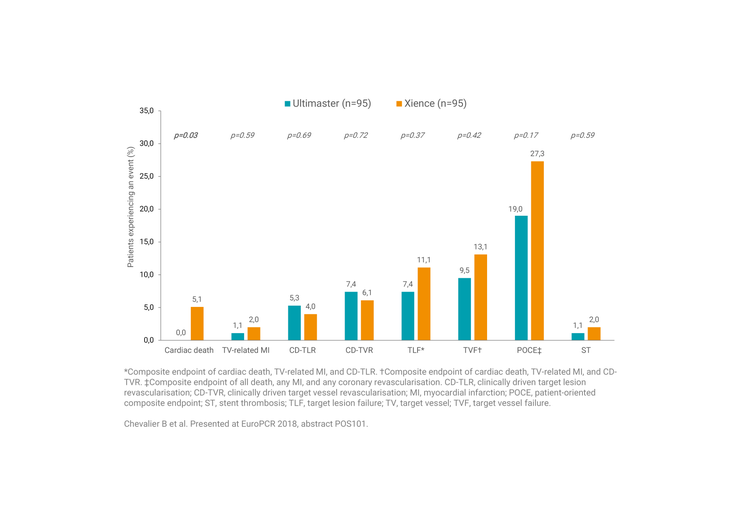
- TLF up to 5 years was 7.4% with Ultimaster, compared with 11.1% with Xience (p=0.37)
- Cardiac death at 5-year follow up was significantly lower in the Ultimaster group than in the Xience group (0.0% vs 5.1%; p=0.03)
TLF, target lesion failure.
Orvin K et al. Catheter Cardiovasc Interv 2016;87:1092–100; Chevalier B. Presented at EuroPCR 2018, abstract POS101.
- There were no significant differences in baseline patient characteristics, lesion characteristics, or procedural characteristics between the two groups
- 69.8% of procedures that used Ultimaster were performed using transradial access, and the overall procedure success rate was 97.8%
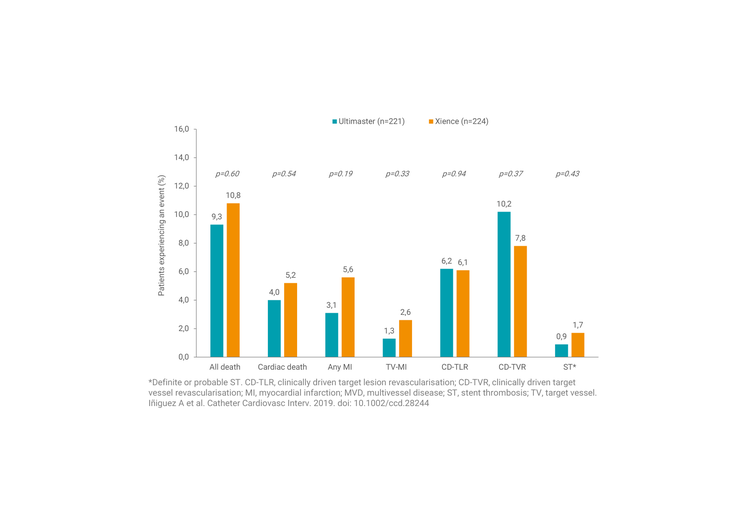
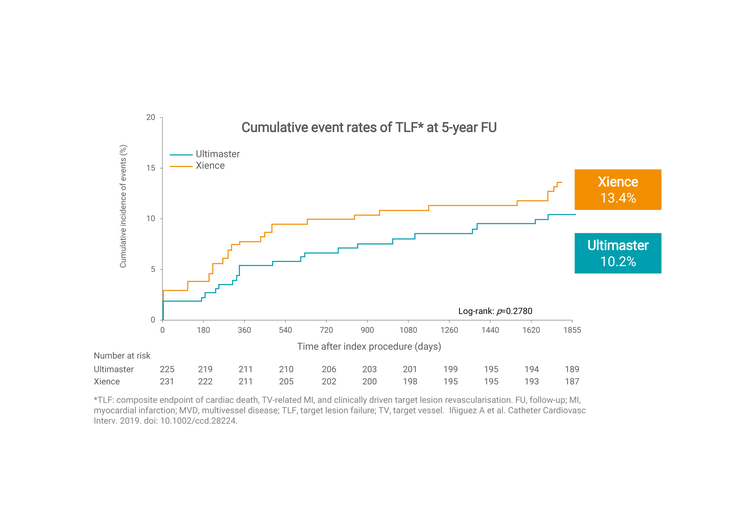
- At 5 years, there was a trend towards better clinical outcomes with Ultimaster than with Xience (statistical significance not met)
- Any death: 9.3% vs 10.8% (p=0.60)
- Any MI: 3.1% vs 5.6% (p=0.19)
- Stent thrombosis: 0.9% vs 1.7% (p=0.43)
MI, myocardial infarction.
Iñiguez A et al. Catheter Cardiovasc Interv. 2019. doi: 10.1002/ccd.28224
-
There were no significant differences in baseline patient characteristics, lesion characteristics, or procedural characteristics between the two groups
- In the Ultimaster and Xience groups, 23.0% and 23.1% of patients, respectively, had STEMI, and 76.9% and 76.8%, respectively, had NSTEMI
- Transradial access was used in 73.0% and 71.7% of procedures with Ultimaster and Xience, respectively
-
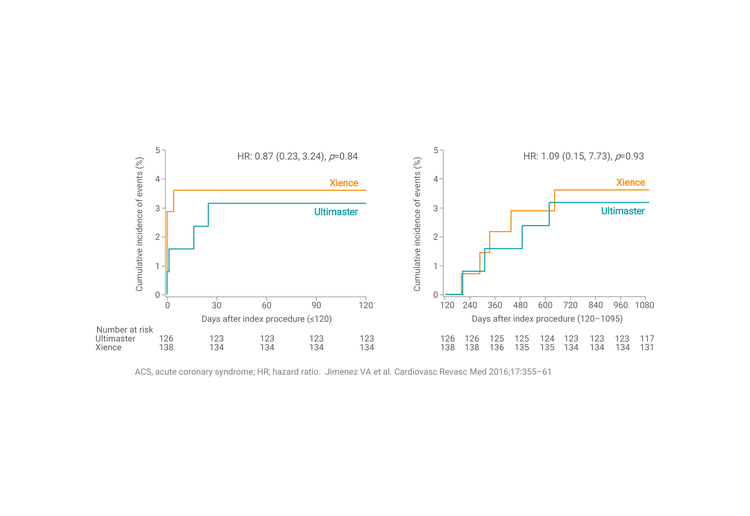
In general, clinical outcomes at 2 years were numerically better with Ultimaster than with Xience
- Any death: 1.5% vs 2.9% (p=0.48)
- Cardiac death: 0.0% vs 2.1% (p=0.10)
- TV-related MI: 0.7% vs 3.6% (p=0.12)
MI, myocardial infarction; NSTEMI, non-ST-segment elevation myocardial infarction; STEMI, ST-segment elevation myocardial infarction; TV, target vessel.
Jimenez VA et al. Cardiovasc Revasc Med 2016;17:355–61; Data on file at Terumo Europe.
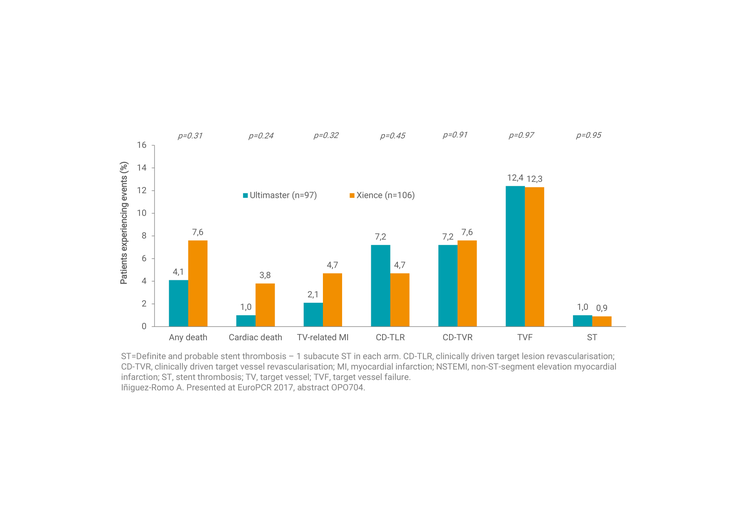
- In general, there were no significant differences in baseline patient characteristics, lesion characteristics, or procedural characteristics between the two groups
- The number of lesions treated was 1.3 with Ultimaster vs 1.5 with Xience (p<0.02)
- Clinical outcomes with Ultimaster were favourable, with low incidences of cardiac death, TV-related MI, and stent thrombosis
MI, myocardial infarction; NSTEMI, non-ST-segment elevation myocardial infarction; TV, target vessel.
Iñiguez-Romo A. Presented at EuroPCR 2017, abstract OPO704;