Balloon occluded TACE (B-TACE) vs DEM-TACE for HCC: a single center retrospective case control study
2
Pierleone Lucatelli, Gianluca De Rubeis, Bianca Rocco, Fabrizio Basilico, Alessandro Cannavale, Aurelio Abbatecola, Pier Giorgio Nardis, Mario Corona, Stefania Brozetti, Carlo Catalano and Mario Bezzi
Lucatelli et al. BMC Gastroenterology(2021)
Featured product: Occlusafe™ Temporary Occlusion Balloon Microcatheter
February 03, 2021
neutrals-100
true
false
Background
Background
Objective
Objective
Methods
Methods
Results
Results
Conclusion
Conclusion
KeyTakeaways
Key Takeaways
Background
3
At the time of publication, scarse evidence was available for B-TACE vs TACE, hence the authors reported data from a single center retrospective experience.
Objective
3
To compare oncological results and safety profile of balloon micro-catheter trans-arterial chemoembolization (B-TACE) and drug-eluting-microsphere (DEM-TACE) in patients with hepatocellular-carcinoma (HCC).
Methods
3
- 149 patients (131 males [87.9%]) with 226 HCC were treated, 22 patients (35 HCC; 19 [86.4%] males) with B-TACE and 127 with DEM-TACE (191 HCC, 112 [88.2%] males).
- Inclusion criteria were: Child–Pugh score up to B8, Barcelona Clinic Liver Cancer (BCLC) stage A and B, not eligible for curative treatments.
- Embolization protocol was standardized (sequential 100 ± 25 and 200 ± 25 μm microspheres).
- Results were evaluated by modified-response-evaluation-criteria-in-solid-tumor [mRECIST] at 1, 3–6 and 9–12 months and time to recurrence after complete response [TTR] at 1 year.
neutrals-100
Results
3
- mRECIST oncological response at all time points (1, 3–6 and 9–12 months) for both treatments were similar, except Objective response rate at 9-12 months.
- Objective response at 1 and 3–6 months between B-TACE vs DEM-TACE [23/35 (65.7%) vs 119/191 (62.3%), 21/29 (72.4%) vs 78/136 (57.4%)].
- On the contrary, at 9–12 months, it was significantly higher in B-TACE subgroup than DEM-TACE (15/19 [78.9%] vs 48/89 [53.9%]).
- The median follow-up time was 143 days, which is higher in B-TACE comparing with DEM-TACE.
- TTR for complete response at 1 year had a better trend for B-TACE vs DEM-TACE (278.0 days [196.0– 342.0] vs 219.0 days [161.0–238.0], OR 0.68 [0.4–1.0).
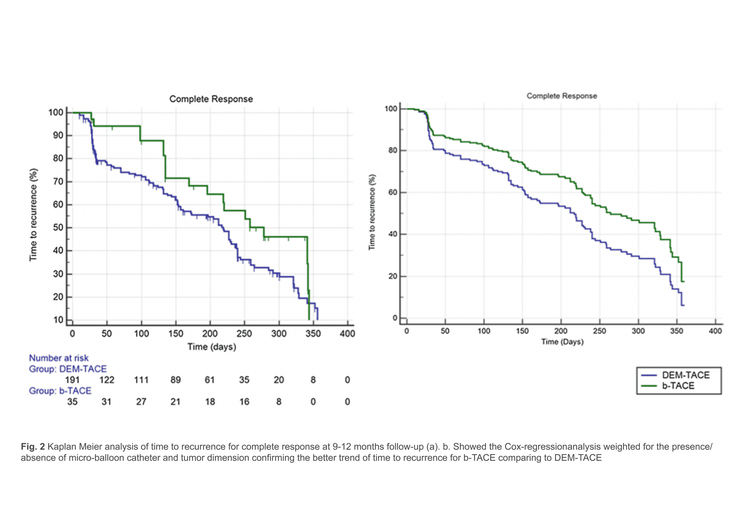
- The use of balloon micro-catheter reduced the relative risk of the event of recurrence by 0.63 [CI95% 0.38–1.04]).
- No significant differences were found in AEs rate.
Conclusion
3
B-TACE showed a trend of better oncological response over DEM-TACE with a longer TTR with a similar adverse events rate, in patients presenting with larger tumors.
Key Takeaways
3
- B-TACE had a better objective response at 9–12 months and higher TTR after CR at 1-year in comparison to DEM-TACE, with a similar AEs rate, in patients presenting with larger tumors.
- These findings suggest a potential advantage of B-TACE for patients with larger tumors.
Featured products
3
default-carousel
true
default-carousel
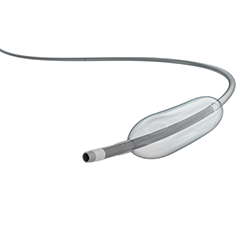
Occlusafe™
Temporary Occlusion Balloon Microcatheter