Percutaneous thermal segmentectomy for liver malignancies over 3 cm: mid-term oncological performance and predictors of sustained complete response from a multicentric Italian retrospective study
2

Lucatelli P. et al. – La Radiologia Medica – Published online 16 September 2024.

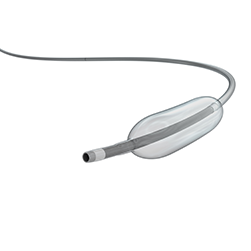
Featured product: Occlusafe™ Temporary Occlusion Balloon Microcatheter

neutrals-100
true
Introduction
Introduction
Studydesign
Study design and method
Baselinecharacteristics
Baseline characteristics
Oncologicalperformance
Oncological performance
Discussion
Discussion
Conclusion
Conclusion
​Introduction
3
For liver lesions >3 cm repositioning of one antenna, use of multiple antennas, combination of ablation and TACE were used. Lately the concept of thermal segmentectomy was proposed. This study verified clinical effectiveness of the technique for >3 cm primary and secondary hepatic tumours.
Study design and method
3
Retrospective collection of data, multicentric. Single-step approach: selective catheterization of the vessel proximal to all tumour’s feeder (with Occlusafe™), inflation of the balloon and measurement of the pressure after the microcatheter tip, MW ablation (different models) at max time/power according to ablation charts. With balloon still inflated, DEM-TACE was performed (LifePearl™ loaded with anthracyclines or irinotecan according to tumour type). ​
Endpoints, data collection and statistical analysis
3
Primary endpoints were oncological outcomes and risk factors associated with not achieving a complete response. mRECIST was used for HCC, RECIST 1.1 for other cancers. FU at 1m, 3-6m and then every 6m until last available FU. Oncological response presented for entire population – HCC only – 3 to 5 cm vs >5 cm.​
Baseline characteristics
3
N. 63 patients treated at 5 Italian centres (SEP 2019 to MAR 2023). HCC n. 49 (77.8%), iCCA n. 4 (6.3%) and metastases n. 10 (15.9%). Median diameter 4.5 cm (n. 37 3-5 cm, n. 26 >5 cm).​
neutrals-100
Oncological performance
3

All combined patients result:

  • N= 6 patients received OLT
  • N = 6 died during FU (median time 9.2m)
  • ​Long term tumour response:
HCC patients result:​
Predictors for obtaining and maintaining a complete response
3

Two cluster of CR failure:

  • At 1m FU and around 9m FU. At 1m FU there were no risk factors detected
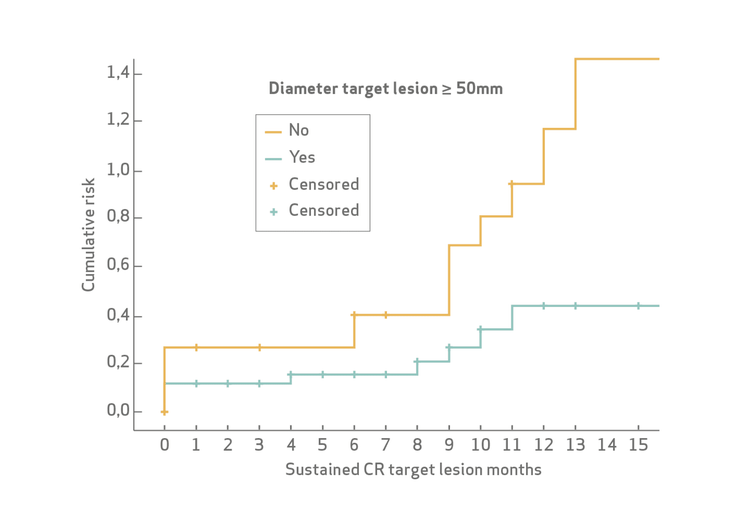
  • At 6m an initial diameter >5 cm was the only independent variable for risk of CR failure (multivariable logistic regression model OR 8.58, P=0.02), while Kaplan-Meier survivor analysis showed a spread after 9m (see Fig. 2)
Discussion
3

Efficacy of the technique was not influenced by the hypo-vascular or hyper-vascular nature of the tumour, hence providing a potential solution for the metastatic lesion that are frequently hypo-perfused.

Percutaneous thermal segmentectomy, as a single-step procedure, is performed in the radiology department and could be a good opportunity for centres without Nuclear Medicine department or with financial constraints.

Limitations are the lack of control, the retrospective design and potential bias in the selection of patients, the limited sample size and the relatively short median FU.​

​Conclusion
3

Percutaneous thermal segmentectomy demonstrated promising mid-term oncological results in liver lesions >3 cm. The best performances were obtained for lesions from 3 to 5 cm. Initial tumour dimension >5 cm was the only risk factor associated with failure of a sustained CR.
Percutaneous thermal segmentectomy demonstrated promising mid-term oncological results in liver lesions >3 cm. The best performances were obtained for lesions from 3 to 5 cm. Initial tumour dimension >5 cm was the only risk factor associated with failure of a sustained CR.

neutrals-100
See full publication
https://clinicaltrials.gov/study/NCT05592171
tisPrimary
Featured products
3