Same-Day Discharge After Percutaneous Coronary Procedures – Consensus Statement of the Working Group of Interventional Cardiology (AGIK) of the Austrian Society of Cardiology
2
neutrals-100
Brandt M.C. et al. 2024 Central European Journal of Medicine.
May 14, 2024
neutrals-100
true
true
Introduction
Introduction
Objective
Objective
StudyGroup
Study Group
Methods
Methods
Results
Results
Conclusion
Conclusion
KeyTakeaways
Key Takeaways
Introduction
3
neutrals-100
Despite low complication rates in PCI and diagnostic angiography, most Austrian centers still require overnight stays. Same-day discharge (SDD) is a safe, efficient alternative supported by strong evidence and growing patient demand. A unified national consensus is needed to guide safe and consistent SDD practices.
neutrals-100
Objectives
3
neutrals-100
- Provide an overview of current SDD Percutaneous coronary procedures (PCP) practices in Austria and internationally.
- Review the latest evidence on the safety and feasibility of SDD.
- Offer a consensus framework for implementing SDD PCP programs in cardiology departments.
- Recommend criteria for selecting suitable patients for SDD.
- Suggest intraprocedural techniques and precautions to enhance safety.
- Define appropriate post-procedure observation periods before discharge.
neutrals-100
Methods
3
neutrals-100
- This consensus was developed using ACC consensus methodology by the AGIK working group.
- Peer-reviewed and integrated with national outpatient clinic guidelines.
- Approved by the Austrian Society of Cardiology.
- Based on 3 SCAI and one ACC SDD PCI documents.
- Supported by a systematic review and meta-analysis on radial access SDD PCI (38,785 patients with SDD and 256,049 patients staying overnight).
neutrals-100
Results
3
International current trends for SDD PCPs:
- It is steadily increasing across the US, Canada, and Europe, with radial access being the key driver.
- SDD PCI in USA: 4.5% (2009) - 28.6% (2017) in 1716 hospitals, with increase in radial access cases from 9.9% to 39.7% and femoral access 4.3% to 19.5%.
- SDD PCI in Canada: 17% (2008) - 45% (2015) from 17 clinics, with higher SDD rates in university-affiliated centres and those with >50% radial access.
- SDD PCI in France: 14% (2008) - 32% (2015) in a single centre.
- There is wide inter-hospital variability, with many centres still discharging <10% of PCI patients on the same day.
- Increasing SDD adoption even as patients become older and more comorbid, with stable or improved safety outcomes.
Current Clinical Practice in Austria:
- 77% of Austrian cardiology centres do SDD procedures, but only 35% perform PCI as SDD, often limited to single-stent cases.
- Two main models exist: SDD beds within regular wards or dedicated outpatient departments shared across specialties.
- Staffing models vary, regular wards offer flexibility with 24/7 staff, while outpatient clinics have dedicated teams focused only on SDD.
- 85% of centres use structured protocols or checklists to evaluate SDD eligibility, with patient volumes ranging from 2/week - 6/day.
- The COVID-19 pandemic led to a rise in SDD adoption across Austrian cardiology centres.
- Implementing outpatient PCI clinics in Austria doesn’t require large investment. At the University Clinic Innsbruck, SDD led to an estimated annual cost reduction of €560,000, mainly due to lower staffing costs.
Hospital Environment Recommendations:
- SDD PCI should be performed in high-volume centres by operators with >500 total and >50 annual procedures.
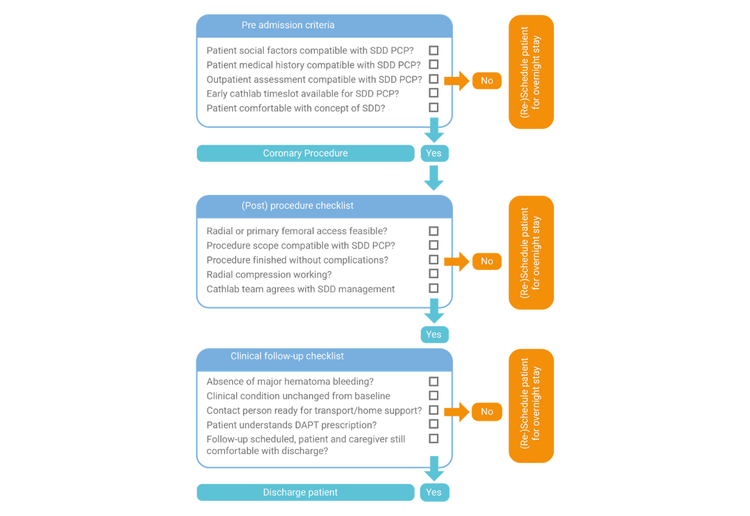
- A structured care pathway should involve secretaries, nurses, cath lab staff, and dedicated outpatient personnel for each step from referral to follow-up.
- An experienced colleague must be available to oversee patient care and discharge to prevent delays.
- Facilities should include lounge chairs or beds with continuous nursing presence and standard surveillance protocols.
- Emergency equipment (defibrillator, ultrasound, ECG) must be readily accessible for safe outpatient care.
neutrals-100
Conclusion
3
- SDD for PCPs is safe and feasible for well-selected patients, including complex cases, when managed by experienced teams in structured outpatient settings offering strong clinical and operational value supported by over 20 years of robust clinical evidence and expert consensus.
- Cost savings and efficiency gains are significant, especially when integrating outpatient clinics into existing infrastructure, with reductions in personnel and hospitalization costs.
- Success relies on three pillars: proper patient selection by experienced cardiologists, adjusting procedural complexity to team expertise, and structured post-procedural care.
neutrals-100
Key Takeaways
3
neutrals-100
- Global evidence and Austrian data support SDD as a patient-preferred, cost-effective model based on strong clinical evidence and practical experience.
- Key elements for success include patient selection, team expertise, and standardized care pathways.
- SDD programs help optimize hospital resources without compromising patient safety or outcomes.
neutrals-100
Featured Solutions
3
neutrals-100
variation-1
cards-2
light-grey-bg
variation-1-card
nothing
Explore Same-Day Discharge
Discover how we are supporting you in your transition towards Same-Day Discharge
Learn more
button