Established in practice, backed by evidence
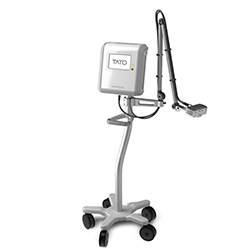
Featured product: TATO Thermal Ablation Treatments for Oncology
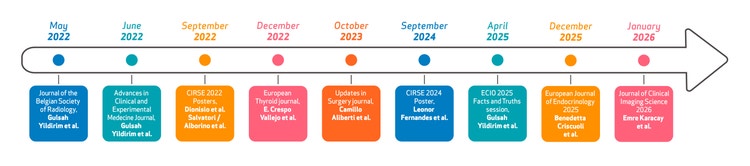
In this publication Dr. Gulsah Yildirim and Hakki Muammer Karakas, at Istanbul Fatih Sultan Mehmet Training and Research Hospital in Turkey, highlighted the safety, feasibility, performance of this system, following up the first 40 patients, without major complications.
Antibody levels and thyroid function tests have remained within normal limits with no significant change during follow-ups. Symptoms and cosmetic scores were significantly improved at all follow-up, obtaining notable volume reductions of the nodules.
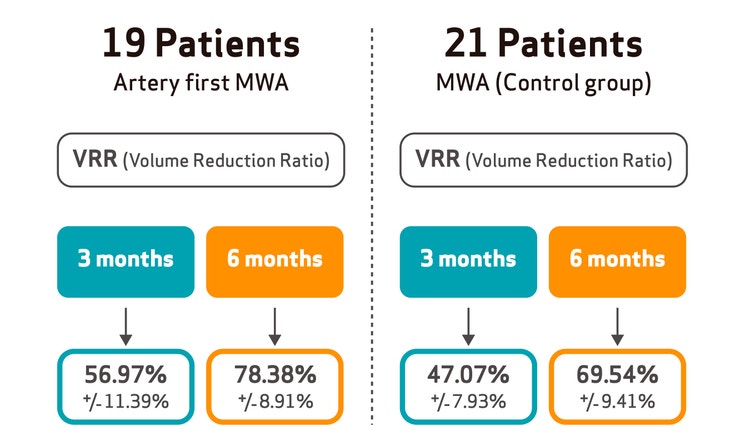
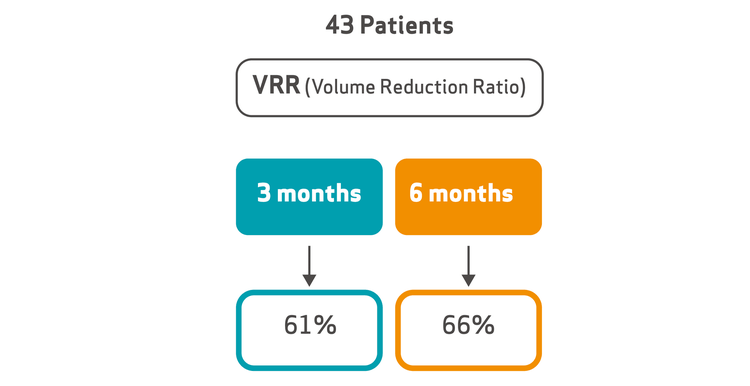
In this publication Dr. Yildirim et al. confirmed the previous results and investigated successfully the option to improve the ablation in highly vascularized nodules by treating the arterial feeder ("Artery first" approach), to obtain a good hemostasis. Notably this approach showed an increased volume reduction at 3 and 6 months compared to the control group.
The study involving 35 patients, reported Uncooled MW ablation of benign thyroid nodules to be an effective treatment both in reducing the volume of the nodule and in improving aesthetics and compression symptoms, confirming the procedure is safe and well tolerated by patients.
In her initial experience, Dr. Dionisio reports similar results to previous publications in terms of safety and effectiveness of the procedure, with follow ups at 1, 6 and 12 months:
- 1 month FU - #5 pts – Volume reduction from 11,3 cc to about 7,00 cc
- 6 months FU - #12 pts – Volume reduction from13,0 cc to around 2,0 cc
- 12 months FU - #2 pts – Volume reduction from 11,2 cc to 0,41 cc
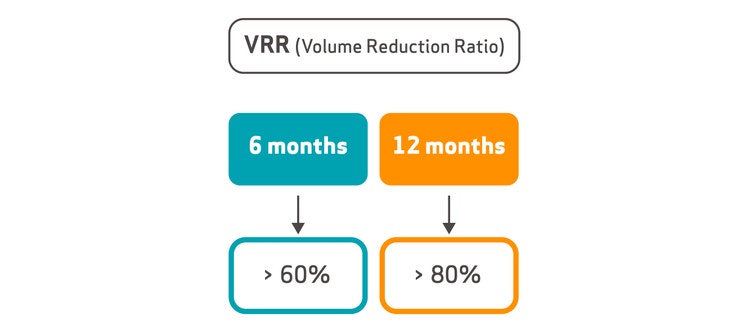
Conclusions: >60% VRR after 6 months, > 80% VRR after 12 months. Disappearance of compressive and cosmetic symptoms of 80% after 1 month and 90% after 6 months. Moreover, she also reported the treatment of two malignant nodules: CT scan at 4 months showed tumor disappearance and absence of locoregional or distant disease progression in both patients.
A novel publication on December 2022, from a single center study conducted by Eduardo Crespo et al. at Hospital Universitario Fundacion Jiménez Diaz, in Madrid, Spain, further consolidated the evidence on safety, performance and clinical outcomes, with a solid follow up of 24 months on 30 patients.
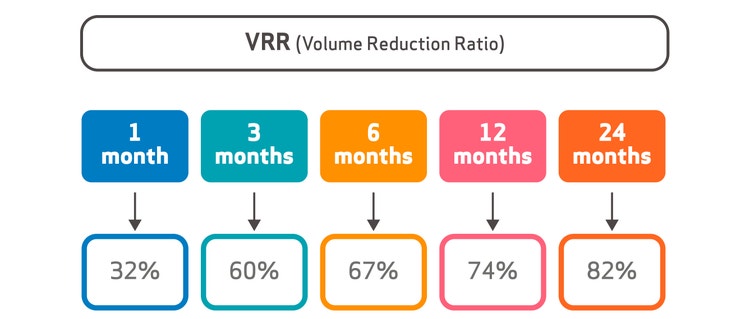
On October 2023, Dr. Aliberti and Dr. Casaril from Pederzoli Hospital in Peschiera del Garda, an Italian center of excellence for thyroid disease, published their experience on BTN Uncooled Microwave Ablation. A novel, dedicated procedure – the fluid-motion technique – was developed and implemented to obtain faster and potentially more effective ablations in all kinds of nodules, with a further confirmation of the results obtained at different European site.
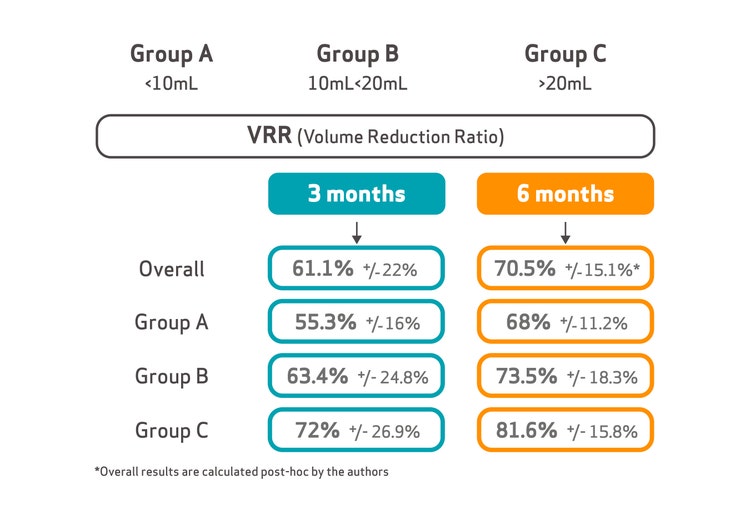
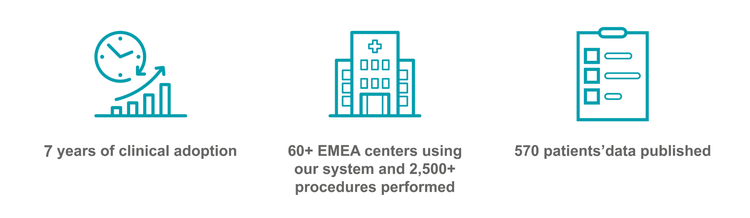
On September 2024, Dr. Fernandes (Hospital Santa Maria, Lisbon) presented their initial experience on 48 patients, confirming that MWA of thyroid benign nodules is well tolerated, cost & risk effective vs. surgery and radioiodine therapy. Retreatment, if needed, can be done safely and effectively (5 patients were retreated within 12 months). To avoid regrowth, ablation of at least 70-80% of the nodule should be obtained.
In April 2025 Dr. G. Yildirim updated her personal results with 3 years follow-up on 45 BTN patients. 5 pts undergone a second treatment at 6 month and N. 3 pts, at 12 months. In these patients the mean neutrophil-to-lymphocyte ratio (NLR) was higher (prognostic factor). Mean initial volume for pts requiring a second ablation was 46.45cc, vs. 19.51cc for patients undergoing a single-session procedure (p<0.01).
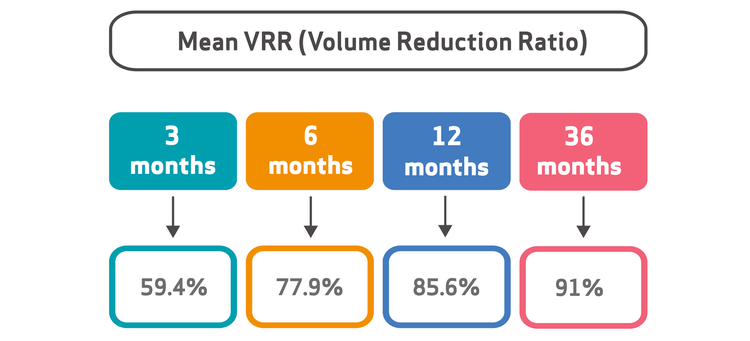
No major complications recorded.
17-18G MW antennas were utilized at 15W to reach 80-100C, obtaining cytotoxic effect, coagulative necrosis followed by phagocytosis. Inflammation response is key to necrotic tissue removal and prevention of regrowth.
This retrospective study included all consecutive patients treated at two thyroid centres of excellence from April 2021 to March 2024 with at least 12m of FU, representing the largest published European cohort of benign thyroid nodule patients treated with Uncooled MWA, using the “Fluid Motion” technique.
A total of 256 patients were treated with follow up (FU) of at least 12 months (baseline, 1m, 3m, 6m, 12m). Among these, a sub-group of N. 86 pts reached a final FU of 24m.
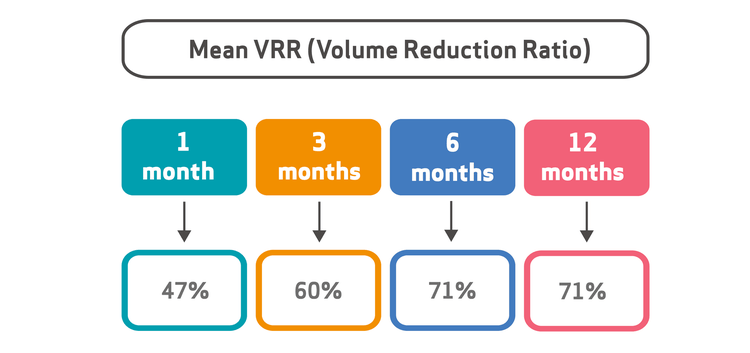
The results show that the maximum volume reduction was obtained already at 6 months, suggesting a superior performance compared to Radiofrequency Ablation which may take up to 12 month to achieve the best response in terms of VRR.
Reduction of symptoms and cosmetic improvements were observed at all FU. Data from the sub-group with 24m FU confirmed the whole cohort results.
Complications were rare (7%), mild to moderate and frequency was in line with previously published literature for RFA and MWA.
Large and very large nodules were successfully treated, regardless of the initial structure, indicating the potential effectiveness and safety of the Fluid Motion technique with uncooled MW for the majority of BTN.
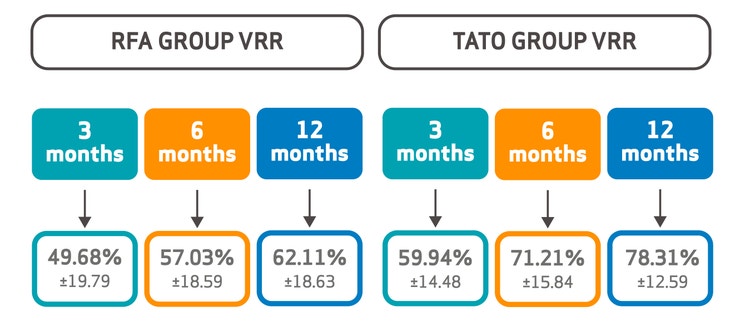
This retrospective study evaluates the effectiveness and complication rates of TATO non-cooled microwave ablation (MWA) system compared to radiofrequency ablation (RFA) system for treating benign thyroid nodules.
62 nodules (56 patients) were included.
At 3, 6, and 12 months, volume reduction was significantly greater in the TATO MWA group.