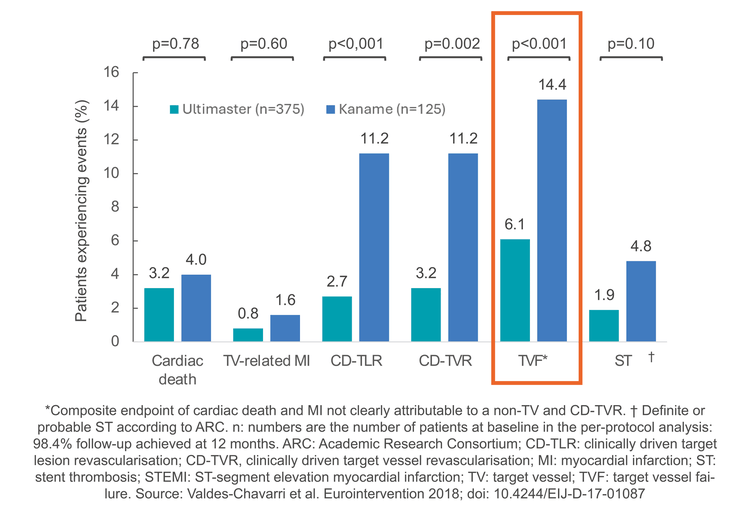
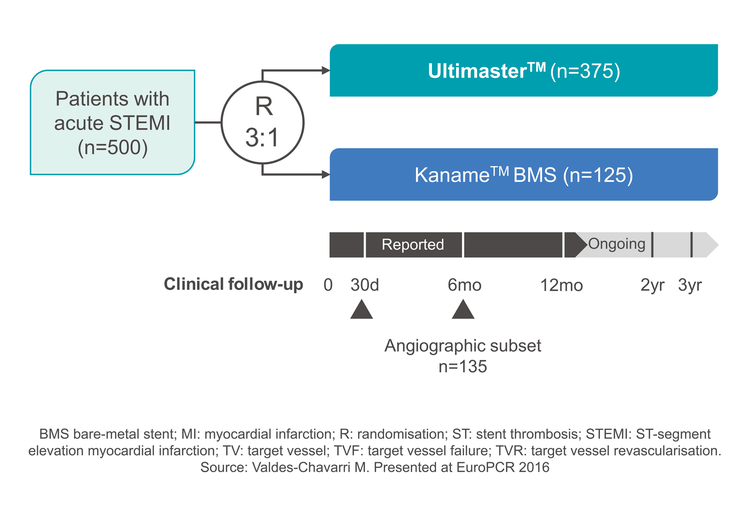
500 STEMI patients, randomised 1:3 vs Kaname BMS, primary endpoint TVF 12M. Published and completed
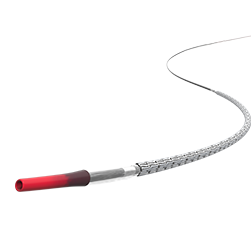
Featured products: Ultimaster Nagomi™ Sirolimus Eluting Coronary Stent System
- confirm safety and efficacy of Ultimaster drug eluting stent used in STEMI patients by proving superiority in efficacy and non-inferiority in safety versus bare metal stent
- generate further evidence for benefits of primary PCI with DES in patients with STEMI
- generate further evidence for benefits of bioresorbable polymer
- randomized (3:1) Ultimaster vs Kaname, single blind
- 500 patients with acute STEMI
- 16 sites
- 5 countries
- Triple primary endpoint at 1 (safety), 6 (efficacy) and 12 months (safety/efficacy)
- Secondary endpoints: clinical, procedural, device related, angiographic...
- Safety (1 month):
composite of all-cause death, recurrent MI, unplanned infarct related artery revascularization, stroke,
definite ST, and major bleeding
- Efficacy (6 months):
In-stent late loss
Efficacy and safety (12 months):
TVF and a composite of cardiac death, recurrent TV MI, TVR
MI, myocardial infarction; ST, stent thrombosis; TV, target vessel; TVF, target vessel failure; TVR, target vessel revascularisation.
Valdes-Chavarri M. Presented at EuroPCR 2016.
-
In general, there were no significant differences in baseline patient characteristics, lesion characteristics, or procedural characteristics between the two groups, with the following exceptions:
- The number of stents per lesion was significantly higher with Ultimaster than with Kaname (1.5 vs 1.3; p=0.04)
- Total stent length per patient was significantly longer with Ultimaster than with Kaname (29.7 mm vs 26.1 mm; p=0.01)
-
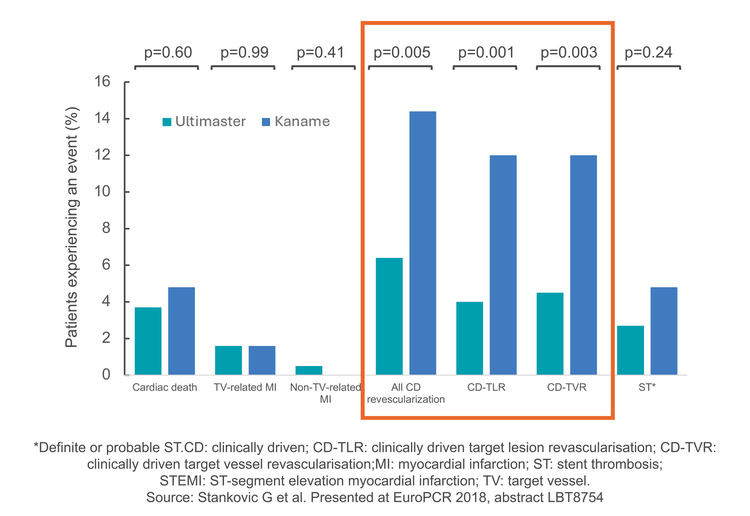
At 3 years, clinical outcomes were significantly better with Ultimaster than with Kaname for all clinically driven revascularisation, CD-TLR, and CD-TVR
CD-TLR, clinically driven target lesion revascularisation; CD-TVR, clinically driven target vessel revascularisation; STEMI, ST-segment elevation myocardial infarction.
Valdes-Chavarri et al. Eurointervention 2018; doi: 10.4244/EIJ-D-17-01087. Stankovic G et al. Presented at EuroPCR 2018, abstract LBT8754.