Challenging Lesion - White Paper
2
neutrals-100

Physician: Prof Laura Crocetti

Location: University of Pisa - Italy

Featured product: TATO Thermal Ablation Treatments for Oncology

neutrals-100
How can TATO help me in ablation?
3
neutrals-100
During the past 20 years, the objectives of ablation research endpoints have been to increase ablation volumes while reducing the procedural times and increasing the reproducibility. This means higher wattage, cooling optimization and larger calibre antennas. Large volumes of coagulative necrosis, however, are not the only achievement that matters in daily clinical practice. While ablation can be considered a minimally invasive treatment, some risks exist and the principle of beneficence against the principle of non-maleficence should be evaluated in order to optimize the treatment, balancing safety and efficacy. By planning an ablation treatment, it is fundamental to take into consideration the presence of factors affecting treatment safety or efficacy.
neutrals-100
Liver Ablation
3
neutrals-100
Treating Patients at high risk of bleeding
3
neutrals-100

Among the potential complications affecting safety, bleeding is the most important to be prevented. Unlike surgeons, Interventional Radiologists do not have direct control of haemostasis. For this reason, ablation is considered as a high bleeding-risk procedure[1].

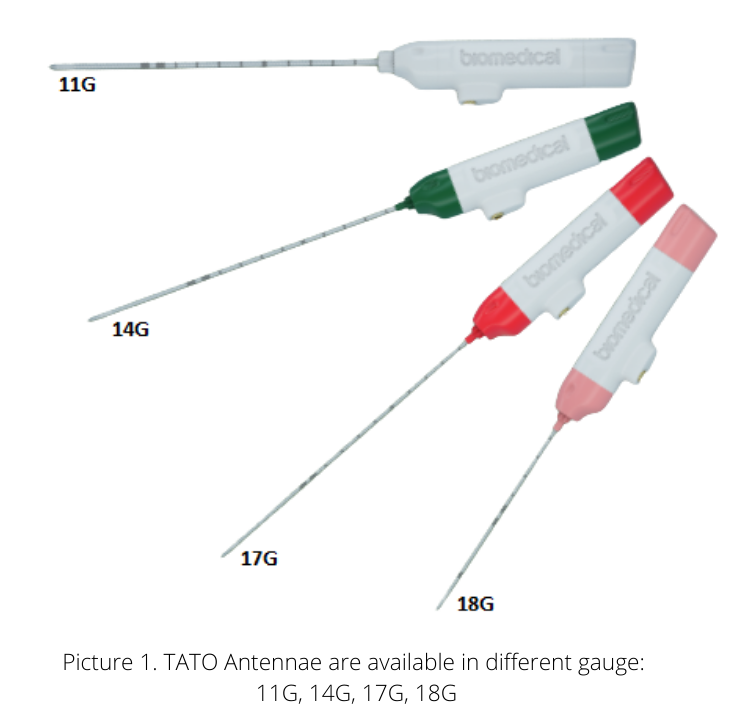
When abnormalities in the coagulation are present, the risk of the occurrence of perihepatic free fluid after intervention or complications of any kind during follow-up is increased[2]. The availability of thinner antennas may be useful in patients at risk, such as those with cirrhosis, abnormal platelets, or elevated values of INR.
neutrals-100
Treating Nodules at high risk of bleeding and/or seeding
3
neutrals-100

Nodules in subcapsular location treated with a direct puncture are at higher risk of bleeding and seeding. The latter especially if the nodule is not well differentiated or presents an invasive tumoral pattern[3]. Therefore, in the treatment of subcapsular nodules, direct puncture should be avoided.

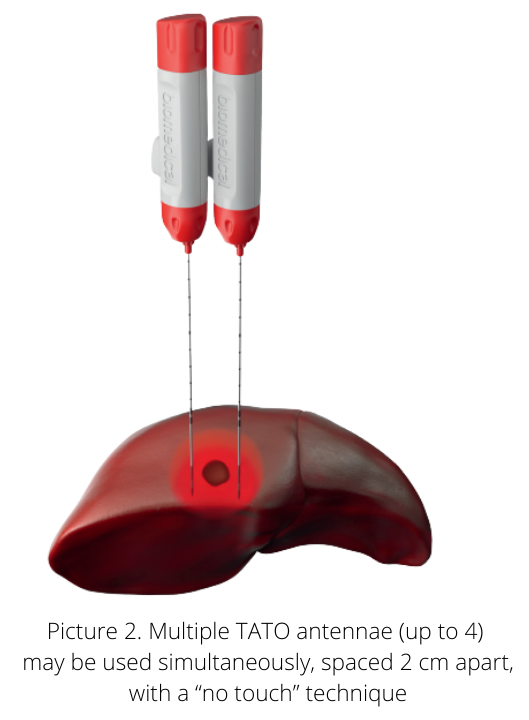
In the impossibility of interposing healthy parenchyma, “no touch” technique has been demonstrated as feasible and useful[4]. Multi-antenna microwave devices can be useful in nodules with subcapsular location and every time the physician prefers a no-touch technique.
neutrals-100
Treating Nodules located near critical structures
3
neutrals-100

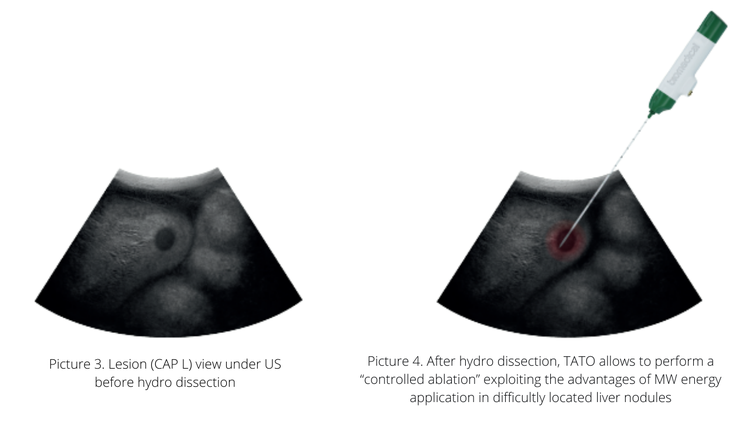
Undesirable thermal damage can also affect safety and a “controlled ablation”, not growing too fast and too much in length is desirable. Structures that can be damaged are represented by:

  • Muscles. Pain may follow ablation for several days or weeks.
  • Main biliary tree. It is possible to perform the cooling of main biliary ducts, even if this procedure is not easy and practical[5]
  • Surrounding viscera, such as the colon or the gallbladder. In such locations, it is advisable to use artificial ascites Dextrose 5% for Radiofrequency (RF) or 0,9% NaCl for Microwave (MW)[6] but it is not always effective. When MW ablation is performed, significant tissue retraction can occur. The use of high power can sometimes induce an important tissue retraction, attracting the viscera near the ablation area even if it has not been classified as a structure at risk at the beginning of the treatment.
neutrals-100
In all those situations, a “controlled ablation” is desirable. While RF ablation is a mild, more controlled, and slowly growing technique, controlled MW ablation should be preferred due to its physical properties. Microwave tissue heating relies on the interaction of an electromagnetic field with water molecules in the tissue, while radiofrequency tissue heating is produced by an electric current going through the needles and the patient[7]. RF heating is limited in areas of low electrical conductivity (where there are no ions to be flipped), such as in the lung or in the bone. On the contrary, MW are capable of propagating more effectively, heating tissues with low electrical conductivity, (high impedance) or low thermal conductivity. Unlike RF, MW heating expands beyond charred or desiccated tissues[8]. MW are also less sensitive to the phenomenon of heat sink effect, that consists in the presence of flowing blood causing a cooling effect, thereby reducing the ablation volume[9].
neutrals-100
Beyond the liver
3
neutrals-100
Lung Ablation
3
neutrals-100

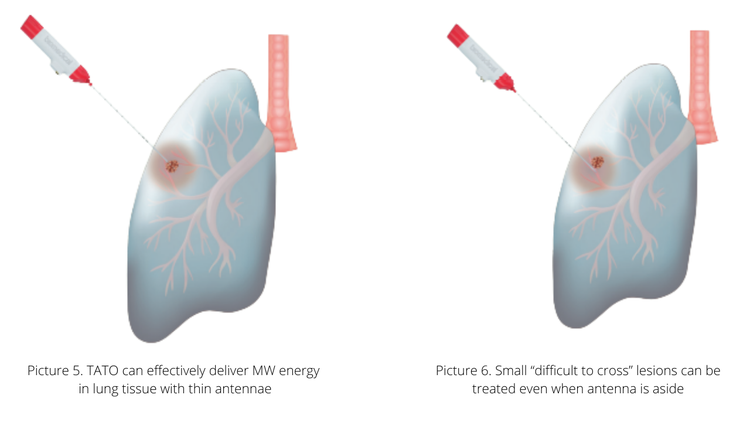
Pneumothorax is the most frequent complication of ablation of primary and secondary lung tumors[10]. It has been demonstrated, in lung biopsy series, that the rate of pneumothorax is related to the calibre of the needle used to puncture the lung[11]. Due to the ability of MW to propagate effectively and heat tissues with low electrical conductivity, high impedance or low thermal conductivity such as the lung, the combination of thin antennae and MW energy delivery could provide better results in lung ablation[12] (Picture 5).

This is especially true in case of small lung nodules such as metastases, which are often difficult to puncture as they might move” in lung parenchyma when touched by the antenna (Picture 6). The antenna can be placed on the side of the nodule and MW energy can effectively propagate and ablate the nodule and the tissue.
neutrals-100
Thyroid Ablation
3
neutrals-100

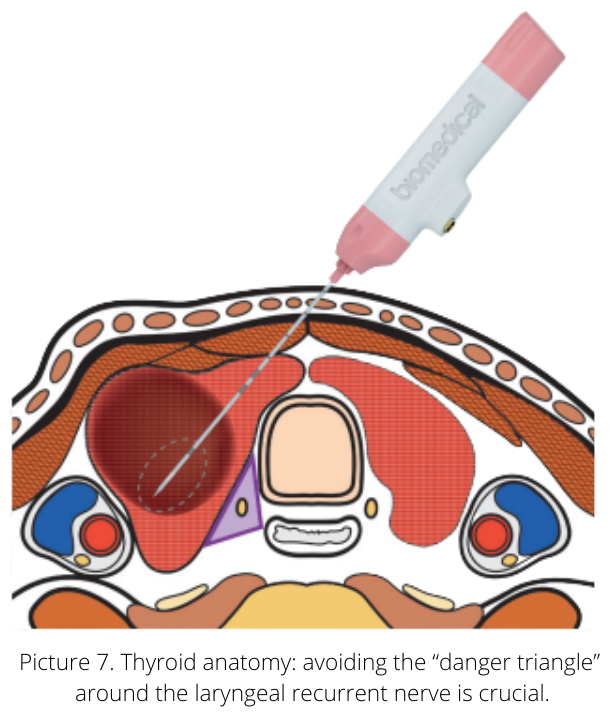
Ablation of benign thyroid nodules or recurrencies of malignant thyroid neoplasms requires the availability of thin and short devices, and the possibility to carefully monitor the treatment[13]. These treatments are usually performed under ultrasound (US) guidance: devices with optimal echogenicity and a slow-growing controlled treatment induced hyper echogenicity are mandatory for a safe treatment. MW could overcome limitations of RF in treating highly vascularized benign or malignant nodules, due to its physical properties[14].

  • 18G x 8 cm length TATO antenna is specifically designed for thyroid ablation. It is highly visible under US and the thermal induced hyper echogenicity grows slowly and in a controlled way
neutrals-100
Currently there are many ablation devices with inherent differences. It is important to know these differences, in order to match the patient/nodule with the correct ablation technique and to balance power and control. TATO may offer advantages in combining MW energy delivered in a controlled fashion and less invasive approach.
neutrals-100

References

Patel IJ, Rahim S, Davidson JC, et al. Society of Interventional Radiology Concensus Guidelines for the Periprocedural Management of Thrombotic and Bleeding Risk in Patients undergoing Percutaneous Image-Guided Interventions - Part II: Recommendations. Endorsed by the Canadian Association for Interventional Radiology and the Cardiovascular and Interventional Radiology Society of Europe. J Vasc Interv Radiol. 2019; 30:1168-1184.
text
https://pubmed.ncbi.nlm.nih.gov/35651913/
Patel IJ, Rahim S, Davidson JC, et al. Society of Interventional Radiology Concensus Guidelines for the Periprocedural Management of Thrombotic and Bleeding Risk in Patients undergoing Percutaneous Image-Guided Interventions - Part II: Recommendations. Endorsed by the Canadian Association for Interventional Radiology and the Cardiovascular and Interventional Radiology Society of Europe. J Vasc Interv Radiol. 2019; 30:1168-1184.
“Artery-first microwave ablation in the treatment of benign thyroid nodules" by Gulsah Yildirim et al. – Advances in Clinical and Experimental Medicine (published online 29 JUN 2022)
text
https://pubmed.ncbi.nlm.nih.gov/35766894/
Biondetti P, Fumarola EM, Ierardi AM, et al. Percutaneous US-guided MWA of small liver HCC: predictors of outcome and risk factors for complications from a single center experience. Medical Oncology. 2020; 5:37-39
https://library.cirse.org/cirse2022/crs/role-of-us-guided-microwave-termoablation-mwa-in-the-treatment-of-benign-thyroid-nodules-btns
text
https://library.cirse.org/cirse2022/crs/role-of-us-guided-microwave-termoablation-mwa-in-the-treatment-of-benign-thyroid-nodules-btns
Bruix J et Llovet JM. Prognostic Prediction and Treatment Strategy in Hepatocellular Carcinoma. Hepatology. 2001; 33:1124-1129
https://library.cirse.org/cirse2022/crs/initial-experience-of-microwave-ablation-for-benign-and-malignant-thyroid-nodules-our-short-term-results
text
https://library.cirse.org/cirse2022/crs/initial-experience-of-microwave-ablation-for-benign-and-malignant-thyroid-nodules-our-short-term-results
Kawamura Y, Ikeda K, Fukushima T, et al. Potential of a no-touch pincer ablation procedure for small hepatocellular carcinoma that uses a multipolar radiofrequency ablation system: An experimental animal study. Hepatol Research. 2014; 44:1234-40.
“Multiple overlapping microwave ablation in benign thyroid nodule: a single-center 24-month study" by Eduardo Crespo Vallejo et al. - European Thyroid Journal (published online 23 DEC 2022)
text
https://pubmed.ncbi.nlm.nih.gov/36562633/
Elias D, Sideris L, Pocard M, et al. Intraductal cooling of the. main bile ducts during radiofrequency ablation prevents biliary stenosis. J Am. Coll Surg. 2004; 198(5):717-21.
“Microwave ablation for large benign thyroid nodules: a proposal for a new approach: the fluid-motion technique" by Camillo Aliberti et al. – Updates in Surgery (published online 29 OCT 2023)​​
text
https://pubmed.ncbi.nlm.nih.gov/37899391/
Kondo Y, Yoshida H, Shiina S, et al. Artificial ascites technique for percutaneous radiofrequency ablation of liver cancer adjacent to the gastrointestinal tract. Br J Society. 2006; 93(10):1277-1282.
Dr. Leonor Fernandes et al. US-Guided Percutaneous Microwave Ablation for Benign Thyroid Nodules – “State of the art” and a Snapshot on Lisbon Update, CIRSE 2024 poster
text
https://library.cirse.org/cirse2024/crs/us-guided-percutaneous-microwave-ablation-for-benign-thyroid-nodules-state-of-the-art-and-a-snapshot-on-lisbon-update?t=1
Lubner MG, Brace CL, Hinshaw JL, et al. Microwave tumor ablation: mechanism of action, clinical results, and devices. J Vasc Interv Radiol. 2010; 21(8):192-203.
Prof. G. Yildirim et al, ECIO 2025 - P-140 / 3 Years Results Of Thyroid Nodule Ablation With Uncooled Microwave Systems, Facts And Truths​
text
https://programme.ecio2025.cirse.org/ecio2025/crs/p-140-3-years-results-of-thyroid-nodule-ablation-with-uncooled-microwave-systems-facts-and-truths
Brace CL. Microwave ablation technology: what every user should know. Curr Probl Diagn Radiol. 2009; 38(2):61-7.
“Two year clinical outcomes of microwave ablation for benign thyroid nodules: results from a multicenter study” by Criscuoli et al. - European Journal of Endocrinology – ​Published in December 2025.
text
https://academic.oup.com/ejendo/article/193/6/631/8323504
Dodd III GD, Dodd NA, Lanctot AC, et al. Effect of Variation of Portal Venous Blood Flow on Radiofrequency and Microwave Ablations in a Blood-perfused Bovine Liver Model. Radiology. 2013; 267:129-136
​“Comparison of two ablation methods in benign thyroid nodules: radiofrequency ablation and non-cooled microwave ablation” by Karacay et al. – Journal of clinical imaging science – Published in January 2026.​
text
https://clinicalimagingscience.org/comparison-of-two-ablation-methods-in-benign-thyroid-nodules-radiofrequency-ablation-and-non-cooled-microwave-ablation/
​“Comparison of two ablation methods in benign thyroid nodules: radiofrequency ablation and non-cooled microwave ablation” by Karacay et al. – Journal of clinical imaging science – Published in January 2026.​
text
https://clinicalimagingscience.org/comparison-of-two-ablation-methods-in-benign-thyroid-nodules-radiofrequency-ablation-and-non-cooled-microwave-ablation/
Huo YR, Chan MV, Habib AR, Lui I, Ridley L. Pneumothorax rates in CT-Guided lung biopsies: a comprehensive systematic review and meta-analysis of risk factors. Br J Radiol. 2020;93(1108):20190866
​“Comparison of two ablation methods in benign thyroid nodules: radiofrequency ablation and non-cooled microwave ablation” by Karacay et al. – Journal of clinical imaging science – Published in January 2026.​
text
https://clinicalimagingscience.org/comparison-of-two-ablation-methods-in-benign-thyroid-nodules-radiofrequency-ablation-and-non-cooled-microwave-ablation/
Iezzi R, Cioni R, Basile D, et al. Standardizing percutaneous Microwave Ablation in the treatment of Lung Tumors: a prospective multicenter trial (MALT study). Eur Radiol. 2020 Sep 30. doi: 10.1007/s00330-020-07299-2
​“Comparison of two ablation methods in benign thyroid nodules: radiofrequency ablation and non-cooled microwave ablation” by Karacay et al. – Journal of clinical imaging science – Published in January 2026.​
text
https://clinicalimagingscience.org/comparison-of-two-ablation-methods-in-benign-thyroid-nodules-radiofrequency-ablation-and-non-cooled-microwave-ablation/
Cervelli R, Mazzeo S, De Napoli L, et al. Radiofrequency Ablation in the Treatment of Benign Thyroid Nodules: An Efficient and Safe Alternative to Surgery. J Vasc Interv Radiol. 2017;28:1400-1408
​“Comparison of two ablation methods in benign thyroid nodules: radiofrequency ablation and non-cooled microwave ablation” by Karacay et al. – Journal of clinical imaging science – Published in January 2026.​
text
https://clinicalimagingscience.org/comparison-of-two-ablation-methods-in-benign-thyroid-nodules-radiofrequency-ablation-and-non-cooled-microwave-ablation/
Teng D, Ding L, Wang Y, Liu C, Xia Y, Wang H. Safety and efficiency of ultrasound-guided low power microwave ablation in the treatment of cervical metastatic lymph node from papillary thyroid carcinoma: a mean of 32 months follow-up study. Endocrine. 2018 Dec;62(3):648-654.
Featured products
3